
Ladders
Extension Ladders in Fiberglass and Aluminum, Two or Three Section and Utility Designs and More
Fiberglass against aluminum rails, Type II to Type IAA duty ratings, two-section and three-section designs to 60 feet, true reach after overlap, and the Werner and Louisville extension models each trade orders.
Buying extension ladders comes down to three choices made before anyone climbs, the rail material, the duty rating and a length that still reaches the roofline once the sections overlap. Nation Wide Ladder works through those choices with you and quotes from the Werner and Louisville extension models contractors order most, covering fiberglass and aluminum two-section ladders, three-section extension designs up to 60 feet and the lighter Aerolite utility series.


- Over 50 years serving contractors
- MA, NH, CT, ME, VT & RI
- Weekly Maine deliveries
Shop Extension Ladders by Type
 Fiberglass Extension LaddersWerner and Louisville fiberglass extension ladders compared by rating, sections, weight and fittings, from the D6200-2 and FE3200…
 Aluminum Extension LaddersWerner and Louisville aluminum extension ladders compared by duty rating, rail, weight and length, from Type II models…
What Extension Ladders Do and Where Each Rail Material Fits
Louisville describes the extension ladder as a portable design that cannot support itself, with sections that slide against each other to change its length, rated for a single climber at once. Because it leans on a wall, an eave, a pole or a cable strand, crews reach for extension ladders on gutters, siding, painting, signs and roof access, wherever a step ladder falls short and a lift would be more machine than the task needs. For step, single and specialty options beside them, see our full ladder best sellers.
Rail material is the first fork in the road. Under OSHA 1926.1053, a ladder that might contact exposed energized equipment needs nonconductive side rails, and Louisville marks each fiberglass extension model safe around electricity and each aluminum one unsafe, and that split decides most choices between fiberglass extension ladders and aluminum extension ladders. Aluminum answers with lighter carrying. At 20 feet, Louisville’s aluminum AE3220 weighs 32 pounds and its fiberglass FE3220 weighs 42, a gap a gutter crew feels by the tenth raise of the day. Fiberglass ladders suit electricians, utility crews and anyone near a service drop, while aluminum ladders suit painters and siding crews who work clear of power.
Before we suggest a rail material, our team checks which power lines run near the building and how high the eaves sit, so the extension ladder on your quote suits the site.

Werner and Louisville Extension Ladders Contractors Order Most, Compared on Rating and Rail
Four flagship models head our extension list. The fiberglass Werner D6200-2 carries a Type IA, 300 pound rating on a two-section frame, and the Louisville FE3200 pairs the same rating with a steel swivel shoe behind a metal shield and outside slide guides, in 16 to 40 foot lengths. Climbers who haul more weight step up to the Werner D7100-2, rated Type IAA for 375 pounds, while the aluminum Werner D1200-2 is the Type II choice at 225 pounds for lighter extension work.
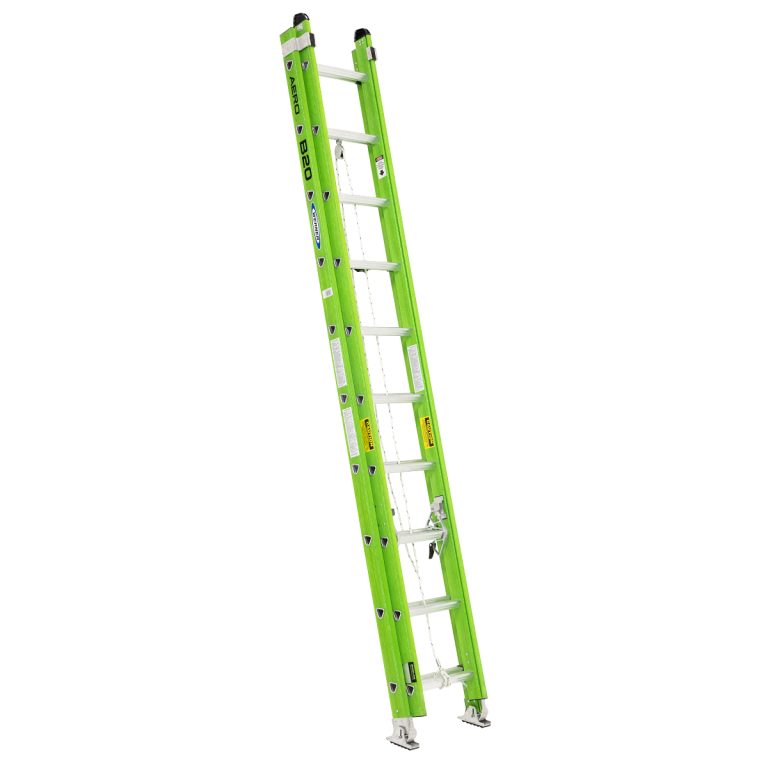
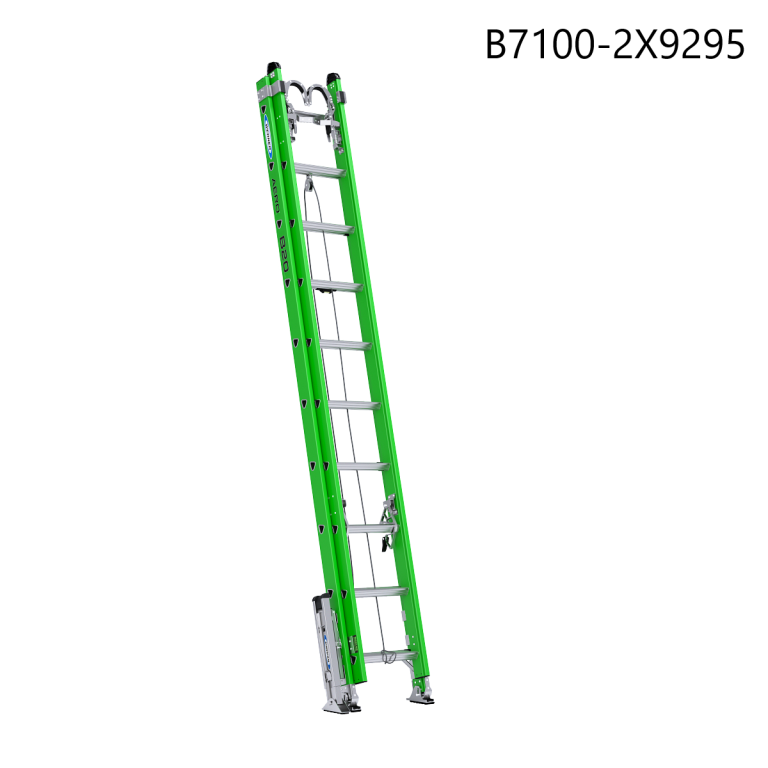
The rest of the aluminum range fills the gaps. Werner rates the D1300-2 Type I at 250 pounds and the D1500-2 Type IA at 300, the D500-2 holds 375 pounds on most lengths up to 48 feet, and Louisville offers the AE1200 and AE2200 at Type IA, the AE3200 at Type I and the AE4200 at Type II. For extra height, the fiberglass Werner D6200-3 adds a third section at Type IA, the Werner 560-3 and Louisville AE1660 reach 60 feet at Type I, and the Werner Aerolite B7100-2 keeps Type IAA while coming in roughly a quarter lighter than comparable 375 pound models. Each maker’s full range sits in our Werner extension ladders and Louisville extension ladders sections.
Long ladders are awkward to haul, so our own delivery trucks bring 40 foot and 60 foot extension models straight to your door anywhere in New England.
Sizing Extension Ladders for Reach, Overlap, Setup Angle and Roof Landings
The number on an extension ladder is the combined length of its sections, not the height it reaches. A 20 foot Louisville extension model tops out at 17 feet once the overlap is taken out, and Louisville gives its reach as 19 feet 10 inches, assuming a climber 5 feet 7 inches tall stretching a foot overhead. Werner keeps climbers no higher than the fourth rung down, and its sizing advice is to buy 7 to 10 feet more ladder than the height of the top support point. You can compare each extension length across both makers on our ladder heights pages.
Roof access adds length again. For a roof landing, OSHA wants 3 feet of rail showing past the edge, and it puts the foot of the ladder roughly one quarter of the working length away from the support, which Werner simplifies to one foot out for every four feet up. A tall gable that defeats a two-section ladder is the job for a three-section extension design. Since OSHA forbids extending or shifting a ladder with someone on it, set the extension height from the ground first.
Free in-person consultations at our Windham NH and Worcester MA showrooms let you raise an extension ladder and test its locks before settling on a length.
Where Extension Ladders Sit in a Complete Exterior Kit
An extension ladder rarely works alone on an exterior job. Siding crews stage planks on ladder jacks between two ladders, painters fit standoff stabilizers to clear gutters, and the longest ladders need a rack on the truck or van just to reach the site. Matching those pieces keeps the ladder, its hardware and its ride consistent, even when they come from different manufacturers.
You will find racks, job boxes and fall protection from every maker we carry lined up in our ladder and truck equipment brands hub.
Extension Ladders Quoted for Contractors and Homeowners
Send us a list of extension ladders by series, length and rating, or call 603-434-6911 in New Hampshire or 508-754-3030 in Massachusetts, and Nation Wide Ladder will quote it with more than 50 years of supplying contractors and homeowners behind the numbers. Our trucks carry orders to Maine, New Hampshire, Vermont, Massachusetts, Rhode Island and Connecticut, and we ship to any address in the US.
Extension Ladders FAQs
Are fiberglass or aluminum extension ladders the safer pick near power lines?
Fiberglass. OSHA requires nonconductive rails where a ladder might contact exposed energized equipment, and Louisville labels its aluminum extension models unsafe around electricity.
Why does a 20 foot extension ladder reach less than 20 feet?
Its sections overlap. Louisville's 20 foot models extend to 17 feet, and the published reach of 19 feet 10 inches assumes an average adult stretching overhead.
Which extension ladders carry a Type IAA rating?
The fiberglass Werner D7100-2 and Aerolite B7100-2, plus most lengths of the aluminum Werner D500-2, which drops to 300 pounds from 36 to 48 feet.
What are the tallest extension ladders you supply?
Two 60 foot three-section models rated Type I, the Werner 560-3 and the Louisville AE1660, which extends to 48 feet once its sections overlap.
What angle should an extension ladder be set at?
Keep the foot about a quarter of the working length from the support, which Werner describes as one foot out for every four feet of height.
Can the sections of an extension ladder be used on their own?
Yes on Werner's D-series, where fly and base come apart so the base can serve as a straight ladder, and the top fly of the 560-3 lifts off too.
Need help choosing the right ladder or truck equipment?
Talk to the team or send us your list and we will put a quote together.