Werner Retractables & Lifelines
Werner Rope Horizontal Lifelines, Kernmantle Kits for Two Workers with Strap or D-Bolt Ends, Two Tensioners and More
Temporary 30, 60 and 100 foot rope systems that pack into a backpack, compared on anchorage ends, tensioning method, energy absorption, connection rules and qualified-person setup.
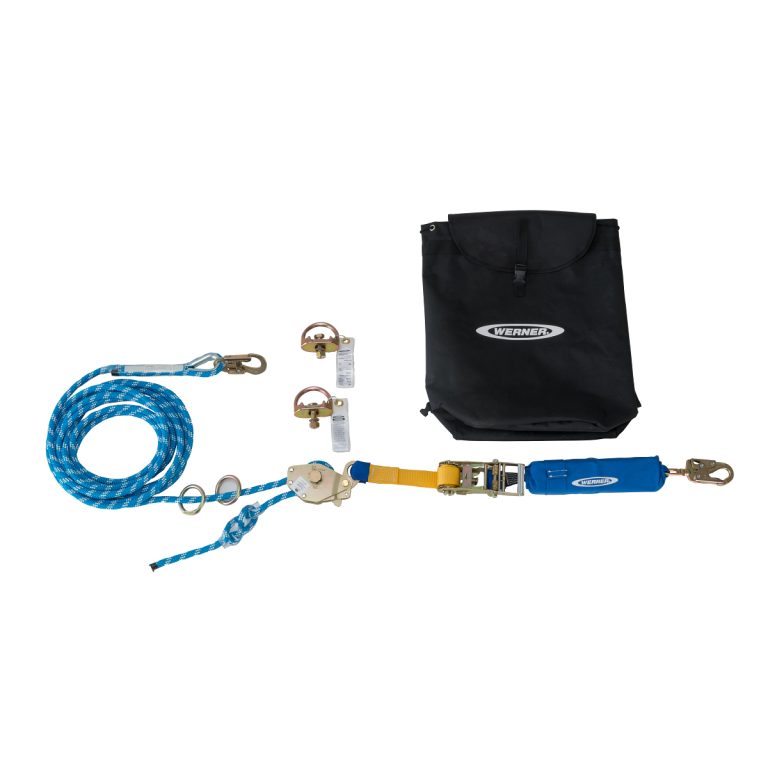
Werner rope horizontal lifelines let two workers stay tied off while they travel a beam, eave or deck edge, by running a kernmantle line between two anchorages with an inline energy absorber built in. Nation Wide Ladder helps crews choose among twelve temporary kits, in 30, 60 and 100 foot lengths, with cross-arm strap or D-bolt anchorage, tensioned by the included rope adjuster or by a ratchet with a built-in tension limiter.



- Over 50 years serving contractors
- MA, NH, CT, ME, VT & RI
- Weekly Maine deliveries
Why Werner Rope Horizontal Systems Suit Crews That Move the Line
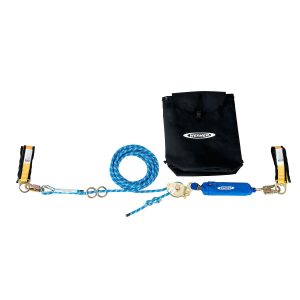
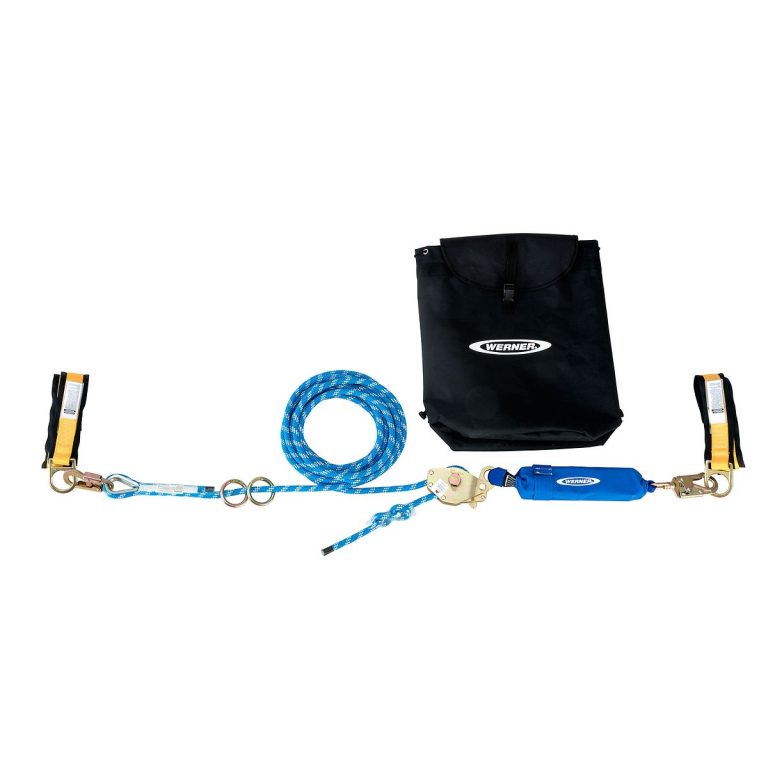
We point crews to Werner rope horizontal lifelines when the line has to come down at the end of a phase and go back up somewhere else. Werner packs each complete kit into a backpack, and the kits we checked on Werner listings weigh roughly 14 to 19 pounds, so one person can carry a system up to the work. Werner sets these up as temporary systems, so a crew can strip the line at the end of a phase, pack it away and set it again on the next bay or building.
Each Werner system serves two users, who connect to the supplied O-rings with a self-retracting lifeline or a shock-absorbing lanyard. Werner lists a snap hook clipped straight onto a horizontal lifeline among the connections that can roll out, so the O-ring is the connection point a worker should use. The inline energy absorber in the Werner line is there to keep the system performing consistently if a fall happens.
Steel line versions sit with our Werner cable horizontal lifelines, and the wider family is in our Werner retractables and lifelines range.
Having supplied roofing and steel contractors for over 50 years, we can tell quickly whether a Werner rope kit or a cable kit suits your crew.
Twelve Werner Rope Kits Sorted by Anchorage End, Tensioner and Length
The Werner model number tells you the ends and the tensioner. L100 Werner kits come with cross-arm straps and are tensioned with the included rope adjuster, while L102 kits keep the straps and switch to a ratchet tensioner with a strap and a built-in tension limiter. L120 and L122 kits follow the same split with D-bolt anchorage instead of straps.
The last three digits give the length in feet, 030, 060 or 100, so the L100030 rope horizontal kit is a 30 foot strap kit with a rope adjuster and the L122100 rope horizontal kit a 100 foot D-bolt kit with a ratchet.
The strap and D-bolt choice is about the structure, not the length. Strap ends suit a beam or column the strap can wrap, and D-bolt ends suit a structure where a bolted anchor point can be fitted. The built-in limiter on the ratchet caps how far the rope can be tensioned, while the rope adjuster keeps the Werner kit simpler. Every kit is listed by Werner as meeting ANSI and OSHA requirements. Werner kits arrive complete, with the line, the ends, the tensioner, the absorber and the O-rings in one backpack, and each worker still brings an SRL or shock-absorbing lanyard to connect.
Come to our Windham or Worcester showroom for a free consultation and see how the strap and D-bolt ends differ before you pick a Werner kit.
Setting Up Rope Horizontal Lifelines Under a Qualified Person
OSHA 1926.502 requires horizontal lifelines to be designed, installed and used under the supervision of a qualified person, as part of a complete personal fall arrest system with a safety factor of at least two. Werner instructions carry the installation, use and clearance requirements for each Werner kit, so they belong in the hands of whoever sets the line.
Werner tests temporary horizontal systems like these as complete systems and states that their components are not interchangeable, so never swap in a rope, absorber or tensioner from another kit or maker.
Before each use, check the kernmantle rope, the inline absorber, the tensioner, the end hardware and the O-rings. OSHA requires any part that has taken an impact load to come out of service until a competent person confirms it is undamaged.
Werner publishes user instructions, a technical data sheet and a Declaration of Conformity for each kit, and the qualified person should keep copies with the site records for the horizontal line.
Saturday morning hours at both of our locations let a crew lead talk through a replacement Werner kit without losing a weekday on site.
Werner Rope Horizontal Kits and the Access That Reaches Them
Horizontal lifelines only help once a crew can reach the beam or eave they span. Ladders, staging and lifts get the crew up, harnesses and connectors join each worker to the O-rings, and the truck racks that carry the gear to site often come from other manufacturers.
You can weigh every maker we stock for that access gear in our ladder and truck equipment brands hub.
Quotes on Werner Rope Horizontal Lifelines by Span
Backpack kits in three lengths, two anchorage ends and two tensioning methods give two-person crews a portable running line for temporary work. Send us the span, the structure at each end and the number of workers, call 603-434-6911 or 508-754-3030, and we will quote Werner rope horizontal lifelines to suit. See the kits in our Werner store or return to the Werner brand page.
Werner Rope Horizontal Lifelines FAQs
How many workers can use a Werner rope horizontal lifeline?
Up to two, each connecting to the supplied O-rings with a self-retracting lifeline or a shock-absorbing lanyard.
What lengths do the Werner rope horizontal kits come in?
30, 60 and 100 feet, with the length shown in the last three digits of the model number.
What is the difference between L100 and L102 rope kits?
Both use cross-arm straps. L100 kits are tensioned with the included rope adjuster, while L102 kits use a ratchet tensioner with a built-in tension limiter.
Can I mix parts from different Werner horizontal kits?
No. Werner tests temporary horizontal systems as complete systems and says their components are not interchangeable.
Who has to set up rope horizontal lifelines?
OSHA requires horizontal lifelines to be designed, installed and used under the supervision of a qualified person.
Need help choosing the right Werner equipment?
Talk to the team or send us your list and we will put a quote together.