
Resources
How to Choose Extension Ladder Height From Reach Charts, Overlap, Roof Clearance, Setup Angle and More
Nominal size against working reach, Werner and Louisville reach figures from 16 to 40 ft, the 7 to 10 foot rule, OSHA's 3 foot landing clearance and minimum section overlap.
Getting extension ladder height right means working back from the gutter, roof edge or wall you need to reach, because the size printed on the rail is not the height you can work at. Nation Wide Ladder helps you choose a two-section or three-section extension from Werner and Louisville, from 16 to 40 ft, using the reach figures each maker publishes, the overlap between sections and the clearance OSHA wants at a roof.
- Over 50 years serving contractors
- MA, NH, CT, ME, VT & RI
- Weekly Maine deliveries
Why the Size Printed on an Extension Ladder Is Not Its Working Height
An extension is sized by adding up its sections. Werner follows the ANSI definition, which counts the combined length of the rail sections with a tolerance of 3 inches per section, and Cal/OSHA describes the size the same way. Once the fly is raised the sections overlap, so the extended length is shorter than the number on the label. Cal/OSHA sets a minimum overlap of 36 inches on two-section ladders up to 32 ft, 46 inches over 32 ft up to 36 ft, and 58 inches over 36 ft up to 48 ft.
Standing level takes a little more. Werner puts the highest standing level on an extension four rungs down from the top. Its reach chart, based on a 5 foot 7 inch person with 12 inches of reach, gives 15 ft of reach for a 16 ft extension, 23 ft for a 24, 31 ft for a 32 and 37 ft for a 40. Louisville quotes a maximum reach instead, such as 15 ft 11 in at 16 ft and 27 ft 7 in at 28 ft, so its figures run slightly higher for the same size. A taller or shorter climber shifts the real figure, so treat any chart as a ladder guide and measure the work height itself.
Over 50 years of matching ladders to homeowners and contractors has taught us to start every extension quote with the height of the job, not the size on the rail.
Measuring the Support Point Before Picking an Extension Height
Measure to the highest point the top of the ladder will rest against, such as the gutter, the eave or a wall plate. Werner then recommends a ladder 7 to 10 ft longer than that point, which covers the setup angle, the overlap, the standing limit and, on roof work, the extra length above the roofline. OSHA’s rule for roof access is that the side rails extend at least 3 ft past the upper landing. If the ladder is too short for that, the top has to be secured to a rigid support and a grab rail or similar device provided.
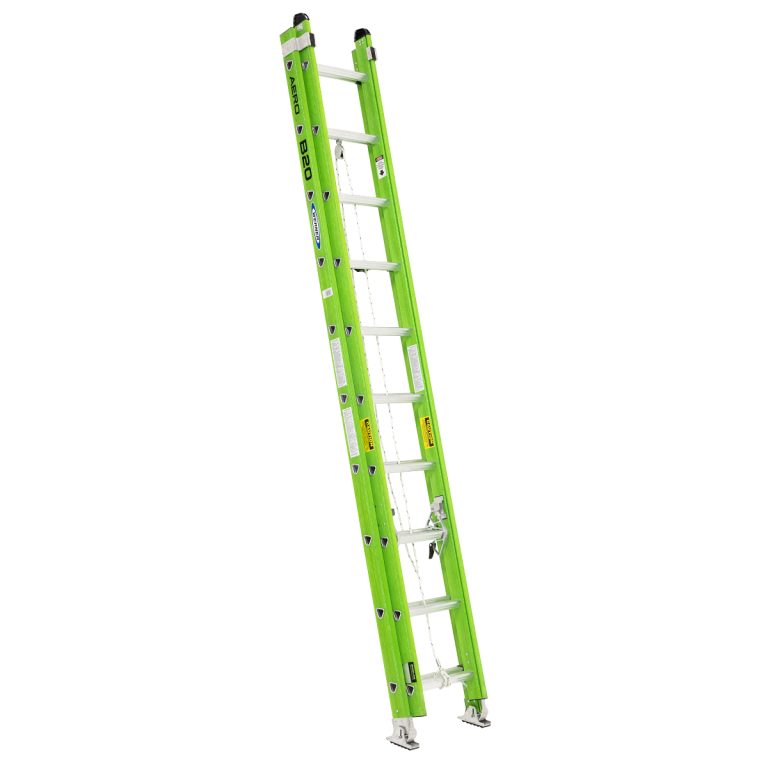
House by house, the heights fall into a pattern. 16 ft extension ladders suit single-storey eaves and porch roofs, and 24 ft extension ladders suit most two-storey gutters and siding. Roof access over a two-storey eave usually moves up to 28 ft extension ladders, while tall gables, third floors and mill buildings call for 32 ft extension ladders or 40 ft extension ladders.
Send our team the measured eave or wall height with a photo, and we will compare it with each maker’s reach figures before recommending a size.

Angle, Overlap and Maximum Length When Setting an Extension Ladder
Setup angle eats into reach. OSHA wants the foot of a leaning ladder about one quarter of the working length out from the top support, and Werner and Cal/OSHA express that as 1 ft out for every 4 ft of height to the support point. Cal/OSHA’s quick check is to stand at the base and reach straight out, and the rail should meet your hand without bending the arm. Keep the rung locks engaged with the fly resting on the base, and never climb while the extension is being raised, since OSHA bars moving or extending a ladder while it is occupied. On sloped ground OSHA allows a ladder only when it is secured, and Werner lists PK80-2 and PK70-1 leg levelers for many of its extension series, which keeps the rails level instead of stacking bricks or blocks under one foot as Cal/OSHA warns against.
There is also a ceiling on size. Cal/OSHA caps a two-section metal extension at 48 ft, a three-section metal one at 60 ft and a two-section reinforced plastic extension at 72 ft, and OSHA bars tying ladders together for extra length unless they are designed for it. When a two-section model gets awkward to carry, a three-section fiberglass ladder such as Werner’s D6200-3 closes shorter, as our Werner extension ladders show.
Our own trucks deliver door to door across New England, so a 32 or 40 ft extension reaches the site without a borrowed trailer.
Extension Height and the Gear That Comes With It
The size you settle on decides the rest of the kit, from the rack length on the truck to the stabilizer that holds the top off a gutter. Our ladders by height section sets Werner and Louisville side by side at every size.
Racks, stabilizers and staging from the other makers we stock are gathered in our ladder and truck equipment brands hub.
Quotes Sized to Your Extension Ladder Height
Measure the support point, add Werner’s 7 to 10 ft, and allow 3 ft past any roof edge you step onto. Send us that figure or call 603-434-6911 in NH or 508-754-3030 in MA, and we will quote the right extension ladder height in fiberglass or aluminum from Werner and Louisville.
Extension Ladder Height FAQs
How do I choose extension ladder height for a gutter?
Measure to the gutter, then follow Werner's advice to choose a ladder 7 to 10 ft longer than the highest support point.
Why is my extension ladder shorter than its size when raised?
Size is the combined length of the sections, which overlap when extended. Cal/OSHA requires at least 36 inches of overlap on two-section ladders up to 32 ft.
How far should an extension go past a roof edge?
OSHA requires the side rails to extend at least 3 ft above the upper landing. If that is not possible, the top must be secured and a grab device provided.
How high can I stand on an extension?
Werner sets the highest standing level at four rungs down from the top.
What reach does a 24 ft extension ladder give?
Werner's chart gives an average reach of 23 ft for a 5 foot 7 inch person with 12 inches of reach. Louisville lists a maximum reach of 23 ft 8 in for its 24 ft models.
How far from the wall should the base sit?
About 1 ft out for every 4 ft of height to the support point, which matches OSHA's one quarter of the working length.
Need help choosing the right ladder or truck equipment?
Talk to the team or send us your list and we will put a quote together.