
Werner Fall Protection Harnesses
Werner Positioning Belts for Harness Hip D-Rings, Tool Pouch Carrying and Padded Back Support, With Sizing and More
The M2100 belt that adds hip D-rings and tool pouch space to a Werner harness, where body belts are allowed under OSHA, positioning limits, hardware rules, sizing and daily inspection.
Werner positioning belts add hip D-rings, tool pouch space and padded back support to a Werner full-body harness, and the challenge is using one only to hold a working posture, never as fall arrest on its own. Nation Wide Ladder helps you fit the Werner M2100 belt to the harness your crew already wears, pair it with a positioning lanyard, and keep the fall arrest connection on the back D-ring.

- Over 50 years serving contractors
- MA, NH, CT, ME, VT & RI
- Weekly Maine deliveries
What Werner Positioning Belts Add to a Full-Body Harness
A standard harness with a single back D-ring handles fall arrest but gives a worker nowhere to clip a positioning lanyard and little room for tools. Werner positioning belts solve both. The M2100 attaches to a Werner harness and brings hip D-rings, space to hang tool pouches in three places, and a fully padded back section for comfort when leaning into the belt.
That suits work where the worker leans back against a structure with both hands busy, such as tying rebar on a wall, setting forms, working on a pole or tower, or fastening on a vertical surface. That lanyard runs from the hip D-rings to the structure and holds the working posture, while the fall arrest connector stays on the harness back D-ring. The belt also lets one harness serve two roles, standard fall arrest on some days and hands-free work on others.
A distributor listing describes the belt as polyester with a buckle closure and lists OSHA 1910 and 1926 approval, and Werner sizes run from small to 2X-large.
Over 50 years of supplying contractors lets us tell you when a belt on an existing harness makes more sense than a separate positioning harness.
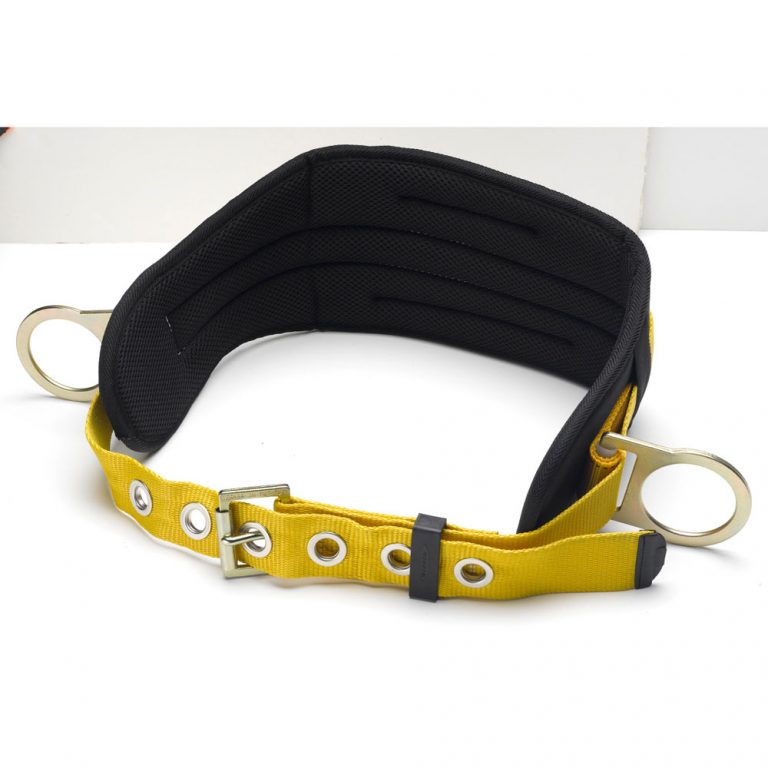
Werner Positioning Belts Versus Built-In Hip D-Rings
Werner also builds hip D-rings straight into positioning and construction harnesses in the Blue Armor, LiteFit and ProForm ranges. A crew that works hands-free on every task may be better served by one of those, because the rings and padding are part of the harness. The Werner M2100 belt makes more sense when a company already owns standard harnesses, when only some tasks need positioning, or when a worker wants a padded belt to carry pouches.
Werner describes the belt as an attachment to any Werner harness, so match it to Werner harnesses rather than another maker’s. Werner warns that fall protection components sold as a system are not interchangeable with other manufacturers’ parts. Fit the belt so the hip D-rings sit at the sides of the hips, and set the harness straps snug before adding pouches so the extra weight does not pull the harness out of position.
Werner positioning belts only carry the load of a working posture. Tool pouches should hold tools, not materials, since OSHA says belts and harnesses are for protecting the worker and never for hoisting materials.
Our team helps you match the belt size and Werner lanyard to the harness and task you describe.
OSHA Rules for Body Belts in Werner Positioning Systems
OSHA 1926.502 is direct about belts. Since January 1, 1998, body belts have not been acceptable as part of a personal fall arrest system, while a body belt in a positioning device system is acceptable. That is why Werner positioning belts work with a full-body harness, never in place of one. A positioning system must be rigged so the worker cannot free fall more than 2 feet, and it must be secured to an anchorage that can hold twice the potential impact load or 3,000 pounds, whichever is greater.
For hardware, connectors must be drop forged, pressed or formed steel or an equivalent material with a corrosion-resistant finish, and D-rings and snap hooks must be proof tested to 3,600 pounds. In power generation and distribution work, OSHA 1910.269 adds that body belt buckles must withstand a 2,000 pound-force tension test and D-rings a 5,000 pound-force tensile test without cracking or breaking. Fall arrest on the back D-ring stays under the separate arrest limits, a 6 foot free fall and 1,800 pounds of arresting force with a body harness.
Send us the task and harness list, or call 603-434-6911 in NH or 508-754-3030 in MA, and we will quote belts and lanyards together.
Werner Positioning Belts Within a Complete Work-at-Height Setup
A belt adds the hip rings, but the positioning lanyard, the fall arrest connector and the anchor complete the system, so all of them are chosen together. The wider Werner harness range covers models with hip rings built in. Ladders, staging and truck racks for the same job usually come from other manufacturers.
Those makers are gathered for you to compare in our ladder and truck equipment brands hub.
Inspecting Werner Positioning Belts Before Each Day’s Work
OSHA requires positioning device systems to be inspected before each use for wear, damage and deterioration, and 1910.269 asks utility crews to inspect work-positioning equipment before use each day. Werner adds an inspection at least once a year by a competent person other than the user. Check the belt webbing for cuts, burns, fraying and chemical damage, look at the stitching around each hip D-ring and the buckle, and confirm the D-rings have no cracks, bends or corrosion.
Tool pouches wear a belt faster where they hang, so look closely at those spots. Any belt with a defect comes out of service, and Werner does not mandate a fixed five year service life, so inspection decides retirement for Werner positioning belts. Clean by hand in a mild soap solution, rinse, wipe dry and hang in a shaded, dry spot, never in a washer or dryer. Store the belt with its harness in a clean, dry place away from sharp tools and chemicals, so pouch hardware does not rub the webbing between jobs.
Both our showrooms keep Saturday morning hours, so a worker can bring a harness in and try a belt size on it.
Quoting Werner Positioning Belts With Matching Harnesses
Our own trucks deliver door to door across New England, and we ship anywhere in the US. Visit the Werner brand page or the Werner store, then tell Nation Wide Ladder the harnesses and tasks on your crew, and we will quote Werner positioning belts with the lanyards that go with them.
Werner Positioning Belts FAQs
Can Werner positioning belts be used for fall arrest?
No. OSHA has not accepted body belts in personal fall arrest systems since January 1, 1998. Use the belt only to hold a working posture, with fall arrest on the harness back D-ring.
What does the Werner M2100 positioning belt attach to?
It is an attachment to a Werner full-body harness, adding hip D-rings, tool pouch space and padded back support.
How far can a worker free fall on a positioning system?
OSHA 1926.502(e) limits a positioning device system to 2 feet of free fall.
What sizes do Werner positioning belts come in?
Werner sizes run from small through medium/large and XL to 2X-large. Give us the harness size and we will match the belt.
Should I buy a Werner belt or a harness with hip D-rings?
A belt suits crews who already own standard harnesses or only position some of the time, while a harness with built-in hip D-rings suits full-time hands-free work.
How often should positioning belts be inspected?
Before each use under OSHA, and at least once a year by a competent person other than the user, as Werner advises.
Need help choosing the right Werner equipment?
Talk to the team or send us your list and we will put a quote together.